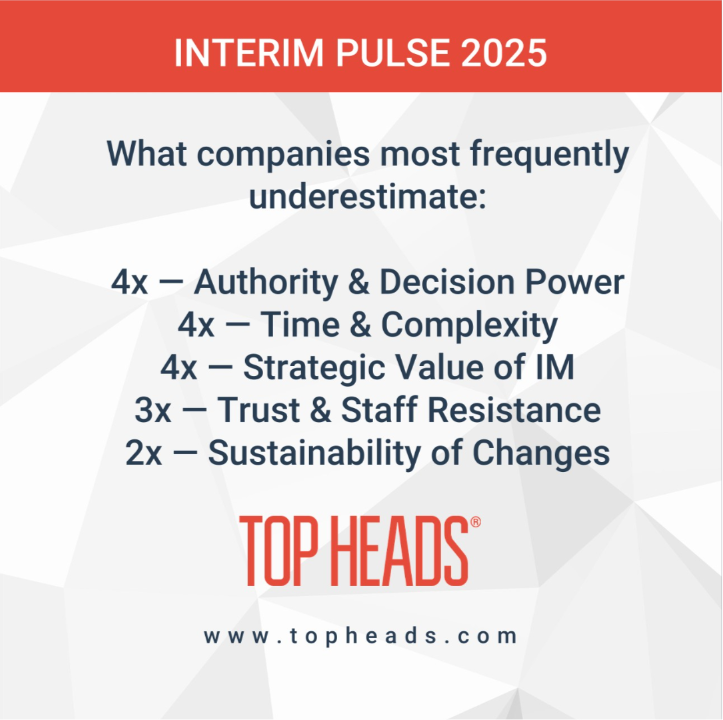


One theme appeared repeatedly in the open responses of the Interim Pulse 2025 research.
Companies often underestimate the importance of authority and decision power when deploying Interim Managers.
This point appeared as frequently as two other major factors:
❗ Time & complexity of projects
❗ The strategic value of interim leadership
In practice, the situation can look like this: A company brings in a senior Interim Manager to lead a transformation, stabilize operations, or navigate a difficult transition.
But the mandate remains unclear.
Decisions still need multiple layers of approval or take too long.
The interim role becomes partly advisory rather than operational.
The result is predictable: slower progress, frustration on both sides, and projects that deliver less than they could.
Interim leadership works best when the expectations are clear from the start:
⭕ What the mandate is
⭕ What authority comes with it
⭕ How the leadership team supports the role internally.
In my experience, the structure of the engagement often determines the outcome more than the individual involved.
If you would like to discuss how to structure an interim engagement effectively, I’m always open to a conversation.
If you’d like the full Interim Pulse 2025 presentation, drop “Interim Pulse” in the comments and we’ll send you the link.